README




Inspiration
Having been introduced to learning Laravel Framework; Over the past yr(s), Coming back to vanilla PHP,
was pretty tough. So i decided to create a much more easier way of communicating with Database, using native PHP PDO:: Driver.
Documentation
Requirements
Installation
Prior to installing database package get the Composer dependency manager for PHP because it'll simplify installation.
composer require tamedevelopers/database
Instantiate
Step 1 — Require composer autoload:
require_once __DIR__ . '/vendor/autoload.php';
Step 2 — [optional] If you want the Package scalfolding
- This will auto setup your entire application on a
go!
- It's helper class can be called, using --
autoloader_start()
| Description |
| It's important to install vendor in your project root, As we use this to get your root [dir] |
| By default you don't need to define any path again |
|
| Files you'll see after you reload browser: |
.env .env.example .gitignore .htaccess .user.ini init.php |
use Tamedevelopers\Database\AutoLoader;

AutoLoader::start();
// then reload your browser to allow the system scalfold for you
init php
- [optional] This will extends the
composer autoload and other setup
- If you used the package
Package scalfolding this file will be
automatically generated, that you can include at the beginning of your project.
Tame Cli
- Custom commands support for CLI
php tame list
tame-cli-scaffold
- Scalffold the database files, instead of running
AutoLoader::start() in browser.
- The
-f|--force flag is needed if you're inside a framework or if on production server.
- This doesn't alter nor replace any files that exists and safe.
php tame scaffold:run --force
tame-artisan-call
- Using the CLI from within php, without the CMD interface.
use Tamedevelopers\Support\Capsule\Artisan;

Artisan::call('db:wipe --force');
BootLoader
- [optional] from
version ^6.0.3 If you do not want to include or use the init.php file
- You can as well call the bootloader, to start the database life-circle.
use Tamedevelopers\Database\Capsule\AppManager;

AppManager::bootLoader();
// app_manager()->bootLoader();
Database Connection
- Take two param as
[$name|$options]
- Mandatory
$name as string of connection name
- [optional]
$options and an array, if no connection data is found
- First navigate to [config/database.php] file and add connection configuration or use .env
DB::connection('connName', $options);
Database Disconnect
- If you want to connect to already connected database, You first need to disconnect
- Takes one param as
string
DB::disconnect('connName');
Database Reconnect
- same as
Database Connection
DB::reconnect('connName', $options);
App Debug Env
- The
.env file contains a key called APP_DEBUG
- It's mandatory to set to false on Production environment
- This helps to secure your applicaiton and exit with error 404
- instead of displaying entire server errors.
| key |
Type |
Default Value |
| APP_DEBUG |
boolean |
true |
Database Connection Keys
- All available connection keys
- The DB_CONNECTION uses only
mysql
- No other connection type is supported for now.
| key |
Type |
Default Value |
| driver |
string |
mysql |
| host |
string |
localhost |
| port |
int |
3306 |
| database |
string |
|
| username |
string |
|
| password |
string |
|
| charset |
string |
utf8mb4 |
| collation |
string |
utf8mb4_unicode_ci |
| prefix |
string |
|
| prefix_indexes |
bool |
false |
Usage
- All Methods of usage
- Without calling the
DB::connection() and passing the driver name you want.
It will automatically be using the default connection driver, you've in your setup'
Table
- Takes a parameter as
string table_name
$db = DB::connection();

$db->table('users');
Insert
- Takes one parameter as assoc array
column_name => value
- It returns an object on success or error
DB::table('users')->insert([
    'user_id'    => 10000001,
    'first_name' => 'Alfred',
    'last_name'  => 'Pete',
    'wallet_bal' => 0.00,
    'registered' => strtotime('now'),
]);

-- To see data, you need to save into a variable
Insert Or Ignore
- Same as
insert() method
- It returns an object of created data or
false on error
DB::table('users')->insertOrIgnore([
    'user_id'    => 10000001,
    'first_name' => 'Alfred',
]);
Update
- Takes one parameter as assoc array
column_name => value
- Returns an
int numbers of affected rows or error
DB::table('users')
    ->where('user_id', 10000001)
    ->update([
        'first_name' => 'Alfred C.',
    ]);
Update Or Ignore
- Same as
update() method
- Returns an
int numbers of affected rows or 0 on error
DB::table('users')
    ->where('user_id', 10000001)
    ->updateOrIgnore([
        'first_name' => 'Alfred C.',
    ]);
delete
DB::table('users')
    ->where('user_id', 10000001)
    ->delete();
destroy
- Take two param as
[value|column]
- Mandatory
value as mixed value
- [optional]
column as Default is id
- Returns an
int
DB::table('posts')->destroy(1);
// Query: delete from `posts` where `id` = ?

DB::table('posts')->destroy(10, 'post_id');
// Query: delete from `posts` where `post_id` = ?
Increment
- Takes three parameter
- Only the first param is required
| param |
Data types |
column required |
string |
count or [] |
int | array |
| param |
array |
1 By default if the the second param not passed, this will increment by 1
DB::table('users')
    ->where('user_id', 10000001)
    ->increment('wallet_bal');
DB::table('users')
    ->where('user_id', 10000001)
    ->increment('wallet_bal', 10);
- You can also pass in a second or third parameter to update additional columns
DB::table('users')
    ->where('user_id', 10000001)
    ->increment('wallet_bal', 100.23, [
        'first_name' => 'F. Peterson',
        'status'     => 1,
    ]);
- You can ommit the second param and it'll be automatically seen as update param (If an array)
DB::table('users')
    ->where('user_id', 10000001)
    ->increment('wallet_bal', [
        'first_name' => 'F. Peterson',
        'status'     => 1,
    ]);
Decrement
DB::table('users')
    ->where('user_id', 10000001)
    ->decrement('wallet_bal', [
        'first_name' => 'F. Peterson',
        'status'     => 1,
    ]);
min
- Take one param as
Expression|string
DB::table('blog')->min('amount');
max
DB::table('blog')->max('amount');
sum
- Take one param as
Expression|string
DB::table('blog')->sum('amount');
avg
- Take one param as
Expression|string
DB::table('blog')->avg('amount');
DB::table('blog')->average('amount');
Fetching Data
| object name |
Returns |
| get() |
array of objects |
| find() |
object | null |
| first() |
object | null |
| FirstOrIgnore() |
object | null |
| FirstOrCreate() |
object |
| firstOrFail() |
object or exit with 404 status |
| count() |
int |
| paginate() |
array of objects |
| exists() |
boolean true | false |
| tableExists() |
boolean true | false |
GET
DB::table('users')->get();
First
DB::table('users')->first();
First or Create
-
Take two param as an array
- Mandatory
$conditions param as array
- [optional]
$data param as array
-
First it checks if codition to retrieve data.
If fails, then it merge the $conditions to $data value to create new records
DB::table('users')->firstOrCreate(
    ['email' => 'example.com']
);
DB::table('users')->firstOrCreate(
    ['email' => 'example.com'],
    [
        'country'   => 'Nigeria',
        'age'       => 18,
        'dob'       => 2001,
    ]
);
First or Fail
- Same as
first() method but exit with error code 404, if data not found
DB::table('users')->firstOrFail();
Count
DB::table('users')->count();
Paginate
- Takes param as
int $per_page
- By default if no param is given, then it displays 10 per page
$users = DB::table('users')
            ->paginate(40);

$users // this will return the data objects
$users->links() // this will return the paginations links view
$users->showing() // Display items of total results
Exists
- Returns boolean
true \| false
DB::table('users')
    ->where('email', 'email@gmail.com')
    ->orWhere('name', 'Mandison')
    ->exists();
Table Exists
- Takes param as
string $table_name
DB::tableExists('users');
Collections
- You can directly use
methods of Collections Instance on any of the below
- All the below
methods are received by Collection class
- get()
- find()
- first()
- firstOrIgnore()
- firstOrCreate()
- firstOrFail()
- insert()
- insertOrIgnore()
Collection Methods
| Methods |
Description |
| getAttributes() |
array Returns an array of data |
| getOriginal() |
object Returns an object of data |
| isEmpty() |
boolean true | false If data is empty |
| isNotEmpty() |
opposite of ->isEmpty() |
| count() |
int count data in items collection |
| toArray() |
array Convert items to array |
| toObject() |
object Convert items to object |
| toJson() |
string Convert items to json |
Collection Usage
- Colections are called automatically on all Database Fetch Request
- With this you can access data as an
object\|array key property
- If no data found then it returns null on
->first() method only
$user = DB::tableExists('users')
            ->first();

if($user){
    $user->first_name
    $user['first_name']
}

$user->toArray()
$user->getAttributes()
- Example two(2)
->get() \| ->paginate() Request
$users = DB::tableExists('users')
            ->where('is_active', 1),
            ->random(),
            ->get();

if($users->isNotEmpty()){
    foreach($users as $user){
        $user->first_name
        $user['first_name']
        $user->toArray()
        $user->getAttributes()
    }
}
Auth
- Lightweight guard-based authentication similar to Laravel.
- attempt() only validates and sets in-memory user; call login() to persist to session.
| method name |
Description |
| guard() |
Create a guard bound to a table and [optional] connection. |
| attempt() |
Validate credentials, set in-memory user on success; does not persist to session. |
| login() |
Persist the current user (or provided array) to session. If userData is not an array, it’s ignored. |
| user() |
Get the in-memory user or rehydrate from session if available. |
| id() |
Get the authenticated user’s id (or custom key). |
| logout() |
Clear in-memory user and remove from session. |
auth-guard
- Set the authentication guard (Takes two param)
- Mandatory
$table param as string
- [optional]
$connection param as string | null database connection name.
use Tamedevelopers\Database\Auth;

$admin = Auth::guard('admins');
Auth Usage
use Tamedevelopers\Database\Auth;

// Create guards
$admin = (new Auth)->guard('tb_admin');
$user  = (new Auth)->guard('tb_user', 'woocommerce');

// Credentials (password is required in attempt)
$credentials = [
    'email' => 'peter.blosom@gmail.com',
    'status' => '1',
    'password' => 'tagged',
];

// 1) Validate credentials only (no session persistence)
if ($user->attempt($credentials)) {
    // In-memory user available
    $user->check();          // true
    $user->id();             // e.g., 123
    $user->user();           // full user array
}

// 2) Persist explicitly (similar to Laravel Auth::login())
$user->login($user->user());   // stores sanitized user in session (no password)

// 3) Retrieve later in another request
$another = (new Auth)->guard('tb_user', 'woocommerce');
$another->user();    // rehydrated from session
$another->check();   // true if session had user

// 4) Logout
$another->logout();  // clears in-memory and session
Pagination
- Configuring Pagination
- It's helper class can be called, using --
config_pagination()
| key |
Data Type |
Description |
| allow |
true | false |
Default false Setting to true will allow the system use this settings across app |
| class |
string |
Css selector For pagination ul tag in the browser |
| span |
string |
Default .page-span Css selector For pagination Showing Span tags in the browser |
| view |
bootstrap | cursor | loading | onloading |
Default simple - For pagination design |
| first |
string |
Change the letter First |
| last |
string |
Change the letter Last |
| next |
string |
Change the letter Next |
| prev |
string |
Change the letter Prev |
| showing |
string |
Change the letter Showing |
| of |
string |
Change the letter of |
| results |
string |
Change the letter results |
| buttons |
int |
Numbers of pagination links to generate. Default is 5 and limit is 20 |
Global Configuration
- 1 Setup global pagination on ENV autostart
most preferred method
AutoLoader::configPagination([
    'allow' => true,
    'prev'  => 'Prev Page',
    'last'  => 'Last Page',
    'next'  => 'Next Page',
    'view'  => 'bootstrap',
    'class' => 'Custom-Class-Css-Selector',
]);
Pagination Query
$users = DB::table('users')->paginate(40);
Pagination Data
$users
// This will return `Collections` of pagination data
Pagination Links
$users->links();
// This will return pagination links view
Pagination Links Config
Read more...
- You can directly configure pagination links
- It'll override the global settings
$users->links([
    'first' => 'First Page',
    'last'  => 'Last Page',
    'prev'  => 'Previous Page',
    'next'  => 'Next Page',
    'no_content'  => 'All videos has been loaded',
])
Pagination Showing
$users->showing();

// This will create a span html element with text
<span class='page-span'>
    Showing 0-40 of 500 results
</span>
Pagination Showing Config
Read more...
- You can configure showing text directly as well
$users->showing([
    'showing'  => 'Showing',
    'of'       => 'out of',
    'results'  => 'Results',
    'span'     => 'css-selector',
])
Pagination Foreach Numbers
- Page numbering
starts counting from 1
- This will format all pagination items collections
- On each page, it starts counting from last pagination item number
$users = DB::table('users')->paginate(20);

foreach($users as $user){
    echo $user->numbers();
}
Pagination Ajax Loading
- When the view is either
loading| | onloading | cursor | bootstrap
- This can automatically fetched data without page load
- You need to give your DOM-element
data-pagination-content and data-pagination-append
$users = DB::table('users')->paginate(20);
<div data-pagination-content>
    <div class="wallet-container" data-pagination-append>
        <?php foreach($users as $user) {?>
            <!-- Content to be loaded structure -->
        <?php }?>
    </div>
</div>

or

<div data-pagination-content data-pagination-append>
    <!-- Content to be loaded structure -->
</div>

<!-- pagination links -->
<div>
    <?= $users->links([
        'no_content' => 'All users have been loaded.'
    ]); ?>
</div>
Get Pagination
- Returns pagination informations
| key |
Description |
| limit |
Pagination limit int |
| offset |
Pagination offset int |
| page |
Pagination Current page int |
| pageCount |
Pagination Total page count int |
| perPage |
Pagination per page count int |
| totalCount |
Pagination total items count int |
$users = DB::table('users')->paginate(20);

$users->getPagination();
Clause
Query
- Allows the use direct sql query
SQL query syntax
- Or direct query exec()
- [important] you cannot use paginate on
query() method
DB::query("SHOW COLUMNS FROM users")
    ->limit(10)
    ->get();


DB::query("ALTER TABLE `langs` ADD COLUMN es TEXT; UPDATE `langs` SET es = en;")
    ->exec();
Select
- Used to select needed columns from database
DB::table('users')
    ->where('user_id', 10000001)
    ->select(['first_name', 'email'])
    ->select('email', 'name')
    ->first();
orderBy
- Takes two param
$column and $direction
- By default
$direction param is set to ASC
DB::table('wallet')
    ->orderBy('date', 'DESC')
    ->get();
orderByRaw
DB::table('wallet')
    ->orderByRaw('CAST(`amount` AS UNSIGNED) DESC')
    ->get();
Latest
- Takes one param
$column by default the column used is id
DB::table('wallet')
    ->latest('date')
    ->get();
Oldest
- Takes one param
$column by default the column used is id
DB::table('wallet')
    ->oldest()
    ->get();
inRandomOrder
DB::table('wallet')
    ->inRandomOrder()
    ->get();
random
Read more...
DB::table('wallet')
    ->random()
    ->get();
limit
- Takes one param
$limit as int. By default value is 1
DB::table('wallet')
    ->limit(10)
    ->get();
offset
Read more...
- Takes one param
$offset as int. By default value is 0
DB::table('wallet')
    ->limit(3)
    ->offset(2)
    ->get();
- Example 2 (Providing only offset will return as LIMIT without error)
DB::table('wallet')
    ->offset(2)
    ->get();
join
- Includes
join|leftJoin|rightJoin|crossJoin
| Params |
Description |
| table |
table |
| foreignColumn |
table.column |
| operator |
operator sign |
| localColumn |
local_table.column |
DB::table('wallet')
    ->join('users', 'users.user_id', '=', 'wallet.user_id')
    ->get();
DB::table('wallet')
    ->join('users', 'users.user_id', '=', 'wallet.user_id')
    ->where('wallet.email', 'example.com')
    ->orWhere('wallet.user_id', 10000001)
    ->paginate(10);
leftJoin
DB::table('wallet')
    ->leftJoin('users', 'users.user_id', '=', 'wallet.user_id')
    ->where('wallet.email', 'example.com')
    ->get();
where
- Takes three parameter
- Only the first param is required
| param |
Data types |
| column |
string |
| operator |
string |
| value |
string |
DB::table('wallet')
    ->where('user_id', 10000001)
    ->where('amount', '>', 10)
    ->where('balance', '>=', 100)
    ->get();
orWhere
Read more...
DB::table('wallet')
    ->where('user_id', 10000001)
    ->where('amount', '>', 10)
    ->orWhere('first_name', 'like', '%Peterson%')
    ->where('amount', '<=', 10)
    ->get();
whereRaw
- Allows you to use direct raw
SQL query syntax
$date = strtotime('next week');

DB::table("tb_wallet")
    ->whereRaw("NOW() > created_at")
    ->whereRaw("date >= ?", [$date])
    ->where(DB::raw("YEAR(created_at) = 2022"))
    ->where('email', 'email@gmail.com')
    ->limit(10)
    ->random()
    ->get();
whereColumn
- Takes three parameter
column operator column2
DB::table('wallet')
    ->where('user_id', 10000001)
    ->whereColumn('amount', 'tax')
    ->whereColumn('amount', '<=', 'balance')
    ->get();
whereNull
- Takes one parameter
column
DB::table('wallet')
    ->where('user_id', 10000001)
    ->whereNull('email_status')
    ->get();
whereNotNull
Read more...
- Takes one parameter
column
DB::table('wallet')
    ->where('user_id', 10000001)
    ->whereNotNull('email_status')
    ->get();
whereBetween
- Takes two parameter
column as string param as array
- Doesn't support float value
| param |
Data types |
Value |
| column |
string |
column_name |
| param |
array |
[10, 100] |
DB::table('wallet')
    ->where('user_id', 10000001)
    ->whereBetween('amount', [0, 100])
    ->get();
whereNotBetween
Read more...
- Same as
whereBetween() method
DB::table('wallet')
    ->where('user_id', 10000001)
    ->whereNotBetween('amount', [0, 100])
    ->get();
whereIn
- Takes two parameter
column as string param as array
- Doesn't support float value
| param |
Data types |
Value |
| column |
string |
column_name |
| param |
array |
[0, 20, 80] |
DB::table('wallet')
    ->where('user_id', 10000001)
    ->whereIn('amount', [10, 20, 40, 100])
    ->get();
whereNotIn
Read more...
Same as whereIn() method
DB::table('wallet')
    ->where('user_id', 10000001)
    ->whereNotIn('amount', [10, 20, 40, 100])
    ->get();
groupBy
DB::table('wallet')
    ->where('user_id', 10000001)
    ->groupBy('amount')
    ->get();
Database Migration
- Similar to Laravel DB Migration
Just to make database table creation more easier
| method name |
Returns |
| create() |
Create table schema |
| run() |
Begin migration |
| drop() |
Drop migration tables |
use Tamedevelopers\Database\Migrations\Migration;
Create Table Schema
- Takes param as string
$table
- [optional] Second parameter
string jobs|sessions If passed will create a dummy jobs|sessions table schema
- It's helper class can be called, using --
migration()
Migration::create('users');
Migration::create('users_wallet');
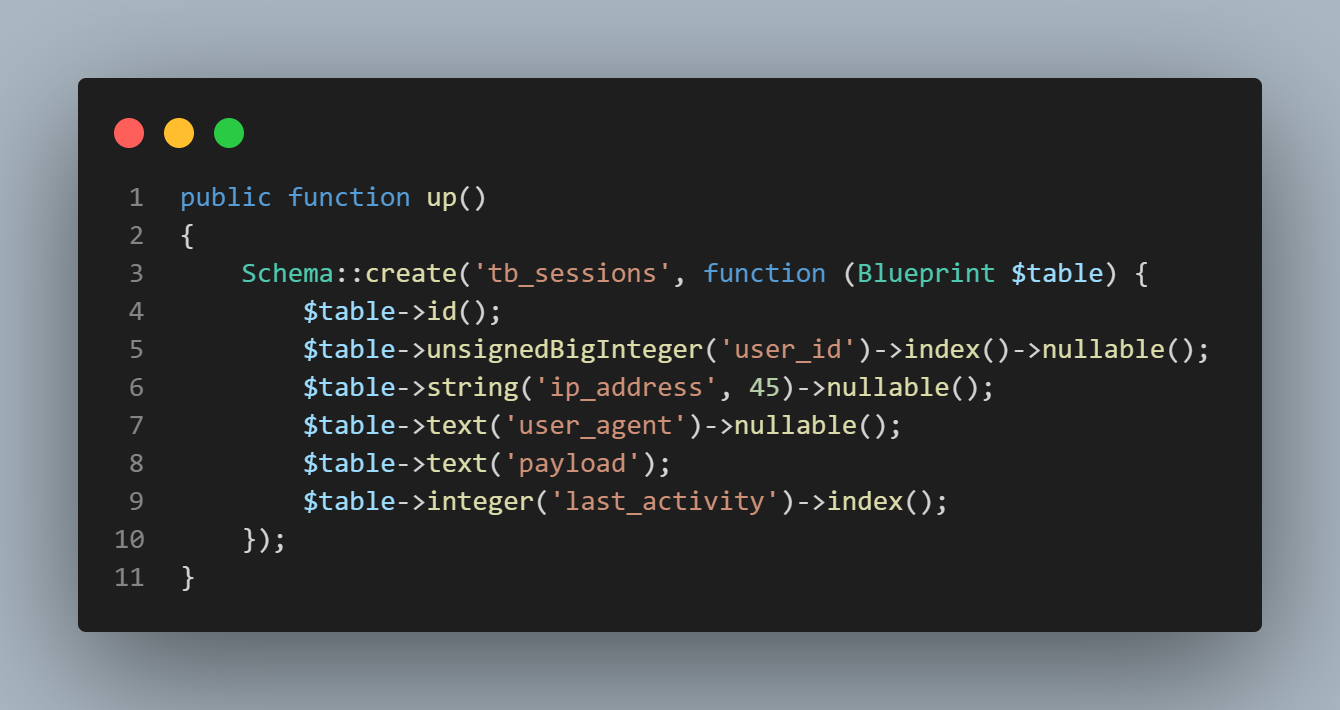
Migration::create('tb_jobs', 'jobs');
Migration::create('tb_sessions', 'sessions');
// migration()->create('users');

// Table `2023_04_19_1681860618_user` has been created successfully
// Table `2023_04_19_1681860618_user_wallet` has been created successfully
// Table `2023_04_19_1681860618_tb_jobs` has been created successfully
// Table `2023_04_19_1681860618_tb_sessions` has been created successfully
Default String Length
- In some cases you may want to setup default string legnth to all Migration Tables
- It's helper class can be called, using --
schema()
| Description |
The Default Set is 255 But you can override by setting custom value |
According to MySql v:5.0.0 Maximum allowed legnth is 4096 chars |
| If provided length is more than that, then we'll revert to default as the above |
This affects only VACHAR |
| You must define this before start using the migrations |
use Tamedevelopers\Database\Migrations\Schema;

Schema::defaultStringLength(200);
// schema()->defaultStringLength(2000);
Update Column Default Value
- In some cases you may want to update the default column value
- Yes! It's very much possible with the help of Schema. Takes three (3) params
$tablename as string$column_name as string$values as mixed data NULL NOT NULL\|None STRING current_timestamp()
use Tamedevelopers\Database\Migrations\Schema;

Schema::updateColumnDefaultValue('users_table', 'email_column', 'NOT NULL');
Schema::updateColumnDefaultValue('users_table', 'gender_column', []);

// or
// schema()->updateColumnDefaultValue('users_table', 'gender_column', []);
Run Migration
- This will execute and run migrations using files located at [root/database/migrations]
Migration::run();

or
migration()->run();

// Migration runned successfully on `2023_04_19_1681860618_user`
// Migration runned successfully on `2023_04_19_1681860618_user_wallet`
Drop Migration
Read more...
- Be careful as this will execute and drop all files table
located in the migration
- [optional param]
bool to force delete of tables
Migration::drop();

or
migration()->drop(true);
Drop Table
Read more...
- Takes one param as
string $table_name
use Tamedevelopers\Database\Migrations\Schema;

Schema::dropTable('table_name');

or
schema()->dropTable('table_name');
Drop Column
Read more...
- To Drop Column
takes two param
- This will drop the column available
use Tamedevelopers\Database\Migrations\Schema;

Schema::dropColumn('table_name', 'column_name');

or
schema()->dropColumn('table_name', 'column_name');
Get Database Config
$db->getConfig()
Get Database Connection
- It's helper class can be called, using --
db_connection()
$db->dbConnection()
Get Database Name
$db->getDatabaseName()
Get Database PDO
$db->getPDO()
Get Database TablePrefix
$db->getTablePrefix()
Database Import
- You can use this class to import
.sql into a database programatically
- Take two param as
[$path|$connection]
- Mandatory
$path as string of path to .sql file
- [optional]
$connection define the connection of database you want to run
use Tamedevelopers\Database\DBImport;

$database = new DBImport('path_to/orm.sql', 'connName');
// new DBImport(base_path('path_to/orm.sql'))

// run the method
$status = $database->run();

// - Status code
// ->status == 404 (Failed to read file or File does'nt exists
// ->status == 400 (Query to database error
// ->status == 200 (Success importing to database
Update Env Variable
- You can use this class to import .sql into a database programatically
| Params |
Description |
| key |
ENV key |
| value |
ENV value |
| allow_quote |
true | false - Default is true (Allow quotes within value) |
| allow_space |
true | false - Default is false (Allow space between key and value) |
use Tamedevelopers\Support\Env;

Env::updateENV('DB_PASSWORD', 'newPassword');
Env::updateENV('APP_DEBUG', false);
Env::updateENV('DB_CHARSET', 'utf8', false);

// env_update('DB_CHARSET', 'utf8', false);
// Returns - Boolean
// true|false
Collation And Charset
- Collation and Charset Data
listing
Collation
- utf8_bin
- utf8_general_ci
- utf8mb4_bin
- utf8mb4_unicode_ci
- utf8mb4_general_ci
- latin1_bin
- latin1_general_ci
Charset
Extend Model Class
Read more...
- You can as well extends the DB Model class directly from other class
use Tamedevelopers\Database\Model;

class Post extends Model{

    // define your custom model table name
    protected $table = 'posts';

    // -- You now have access to the DB public instances
    public function getPost(){
        return $this->select(['images', 'title', 'description'])->get();
    }
}
Helpers Functions
| function name |
Description |
| db() |
Return instance of new DB($options) class |
| db_connection() |
Same as $db->dbConnection() |
| config_pagination() |
Same as $db->configPagination() or AutoLoader::configPagination |
| autoloader_start() |
Same as AutoLoader::start() |
| env_update() |
Same as Env::updateENV method |
| app_manager() |
Return instance of (new AppManager) class |
| import() |
Return instance of (new DBImport)->import() method |
| migration() |
Return instance of (new Migration) class |
| schema() |
Return instance of (new Schema) class |
Error Dump
| function |
Description |
| dump |
Dump Data |
| dd |
Dump and Die |
Error Status
- On error returns
404 status code
- On success returns
200 status code
Useful Links
